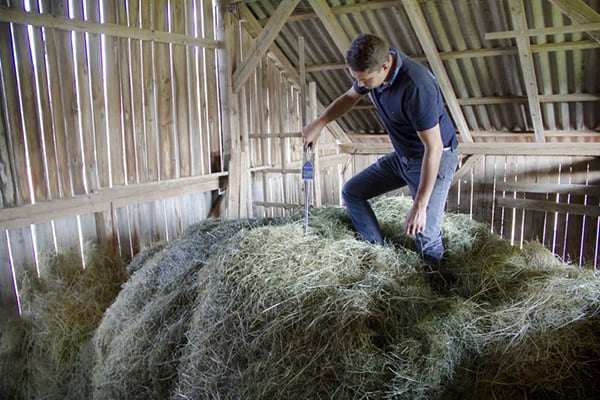
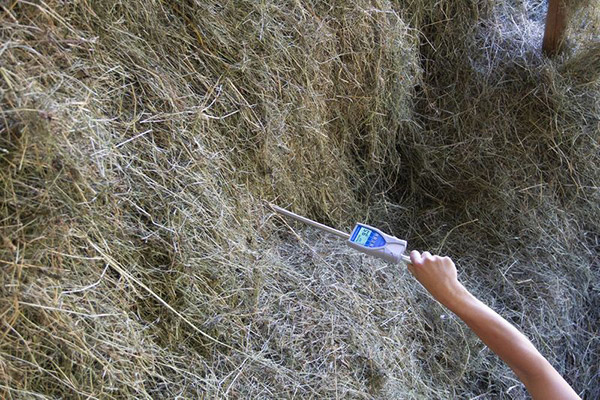
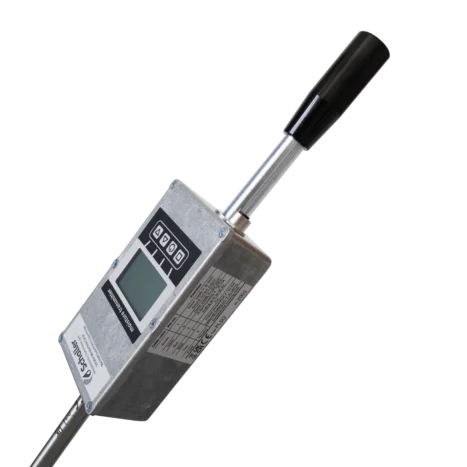
Continuous hay moisture measurement during forced dryingForced drying costs what it takes in time. Too short, and the hay reaches the stack too wet: it heats, moulds and loses feeding value. Too long, and the fan burns electricity while the over-dried hay crumbles and sheds its leaves, the part that carries the protein. Between the two lies a difference of a few percentage points of water content, and no hand can judge that. The FLSO is driven into the hay on its lance and measures without interruption. Water content and temperature appear on the display and go out on the current outputs at the same time, so the transmitter can serve as the sensor for the fan control. Nobody has to climb onto the stack with a hand-held meter. |
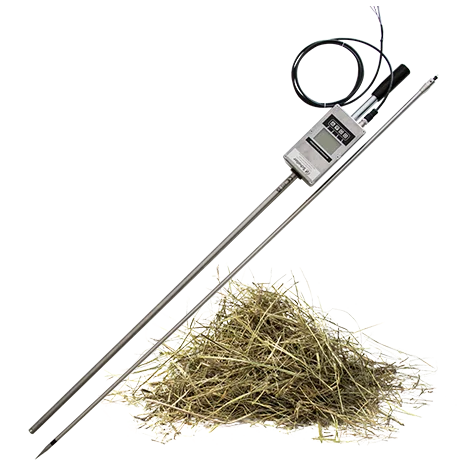 |
Moisture and heat build up deep in the layer, not on the surface. The two metre lance reaches into the stack and the measuring tip works from -10 to +70 °C, so it also registers the material heating up.
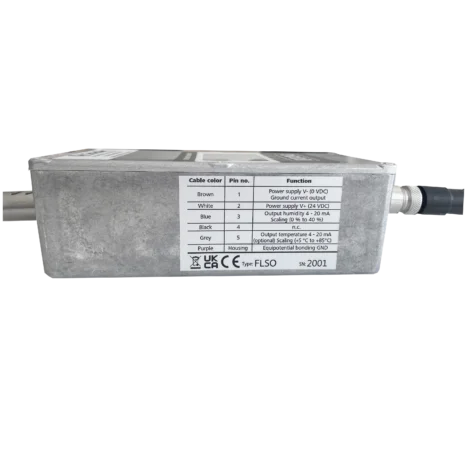
4-20 mA outputs drive the dryingWater content goes out on a 4-20 mA output scaled 0 to 40 %, temperature on a second 4-20 mA output covering +5 to +85 °C. A fan controller, a data logger or a farm monitoring system can take the signal. Power supply 24 VDC, current consumption 90 mA. |
 |
Readout on the device itselfThe housing carries a display and three keys. The menu sets the language (English included), the temperature unit, averaging, backlight time, the crop calibration, a password and a reset. |
 |
The device averages the readings it has stored, so a batch is not judged on a single insertion. The manufacturer notes that differences of up to ±3 % against the drying oven are normal, because the FLSO covers far more material than the sample weighed out for drying.
Both have a 2 metre lance and measure the same thing. The humimeter FLS plugs into a hand-held meter: you take it along when the stack has to be walked and checked at several points, and unplug it for transport. The FLSO stays in the material and hands its result to the control system. For a routine check of the stack the probe is handier; for running the drying, the transmitter is.
| Article no. | 13990 |
| Water content measuring range | 10 to 40 % |
| Calibration curve in the device | loose hay, 10 to 30 % |
| Calibration accuracy to reference method | ±0.8 % |
| Resolution | 0.1 % |
| Temperature measuring range | +5 to +85 °C |
| Temperature range of the measuring tip | -10 to +70 °C |
| Temperature compensation | automatic |
| Operating temperature for water content measurement | +5 to +40 °C |
| Power supply | 24 VDC (15 to 29 VDC) |
| Current consumption | 90 mA (without output and display) |
| Water content output | 4-20 mA, scaled 0 to 40 % |
| Temperature output | 4-20 mA, +5 to +85 °C |
| Protection class | IP 54 |
| Lance length | 2 m |
| Dimensions | 2260 × 65 × 40 mm |
| Menu languages | English, German, French, Italian, Spanish, Portuguese, Czech, Polish, Russian, International |
FLSO transmitter, insulating disc, connection cable of 1.9 m with moulded 5-pole plug, operating manual. Both analogue outputs, for water content and for temperature, are standard.


 Polski