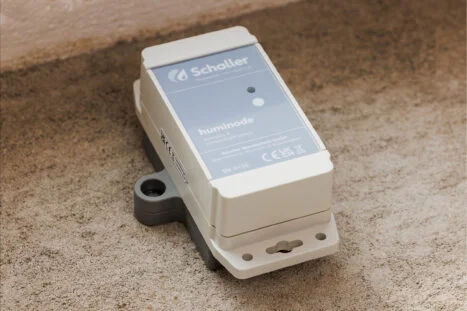
The huminode IoT LW is a wireless sensor that measures moisture and temperature directly in the material and sends the results to a dashboard by itself. Instead of returning to the measuring point with a handheld meter, you get a continuous record of the state of the material, including from places that are hard to reach.
The device is made for building and structural elements, roof trusses and timber structures, historic buildings, and bulk materials such as wood chips or pellets. The record of the whole period stays in the system, so the course of drying or storage can be documented and not merely checked on the spot.
How the huminode system worksThe system has three parts. The sensors sit at the monitored points and take the measurements. The LoRaWAN gateway receives their data - one gateway serves many sensors, and the manufacturer states a range of up to 10 km depending on the surroundings and the buildings. The dashboard gathers everything in one place: current readings, history, charts and alarm thresholds. LoRaWAN carries small portions of data over long distances at very low current consumption. That is what lets the sensor run on a built-in lithium battery and need neither a power supply nor signal cabling. |
 |
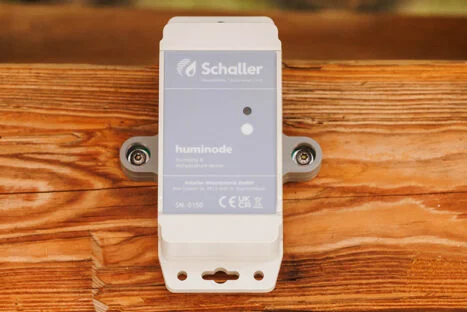
An electrode driven straight into the materialThe sensor is fixed through an electrode connector directly in the material under examination. The screw-in double electrode holds the device in the wood and measures moisture and temperature continuously. For wood chips, pellets, soil and other bulk materials there is a ram-in electrode. The electrode is not part of the delivery; it is chosen separately to suit the material. |
 |
Once the LoRaWAN connection is established, all further settings, analyses and supervision functions are handled centrally in the dashboard, without access to the sensor itself. The interval at which a measured value is determined is set individually, from 15 minutes to several hours, so the measuring frequency can be matched to how fast the material changes.
The manufacturer accepts orders for huminode IoT LW sensors from 5 units upwards.
Advantages
|
 |
| Calibration accuracy against the reference material | according to the electrode |
| Measuring range | according to the electrode, resolution 0.1 % |
| Temperature compensation | automatic |
| Result | the interval at which a value is determined is set individually, from 15 minutes to several hours |
| Communication | LoRaWAN |
| Dimensions of the base device | 150 x 65 x 45 mm |
| Weight of the base device | 260 g |
| Power supply | built-in lithium thionyl battery |
| Article number | 15100 |
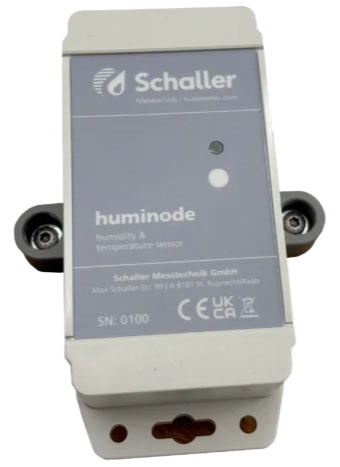
huminode IoT LW base device in a case. The electrode is chosen separately, a huminode IoT gateway is needed to receive the data, and a dashboard licence per sensor to view and archive the measurements.
The two sensors share the system - the same gateway, the same dashboard, the same battery operation - and differ in what they measure. The LW measures the moisture of the material itself through an electrode driven into it. The huminode IoT RH measures the humidity and temperature of the air, with an air probe or a ram-in probe. A structure being dried is monitored with the LW; the climate of the hall around it with the RH.


 Polski