A mill, a dryer or an intake point judges a batch from a sample: somebody goes for the grain, carries it to the meter and writes the reading down. A quarter of an hour or an hour passes between one sample and the next, and the moisture of the flow moves in the meantime - another batch, another place in the heap, another stage of drying.
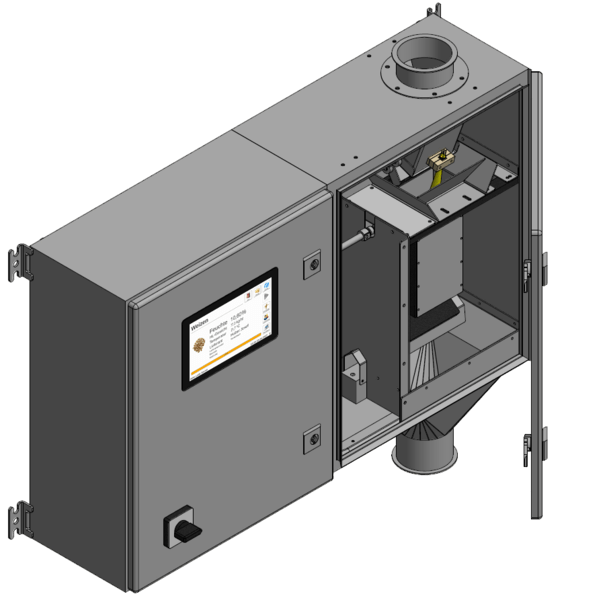
The FSO sits in a bypass loop beside the main flow and measures by itself. It takes a portion of grain, weighs it, measures water content and temperature, empties the chamber and starts again. The reading goes to the display and to the current outputs, so it can feed the dryer control or the intake documentation without an operator.
Part of the flow passes through the measuring chamber while the rest carries on its way. One portion is about 800 ml, a measurement takes 15 seconds, and the flow through the chamber reaches 3.2 l/min. Emptying the chamber needs compressed air: a Ø4 mm connection at 5 bar ±0.5 bar. How the system is tied into the plant is worked out individually, to fit the existing installation; the manufacturer supplies an installation diagram.
Water content is measured by a high-frequency capacitive method. At the same time the integrated scale gives the hectoliter weight and compensates the bulk density, and an infrared sensor measures the grain temperature and compensates its effect on the reading. Calibration accuracy is ±0.4 % water content, and the display resolution 0.01 %.
The system arrives ready to work, with every calibration curve common in Europe stored: maize, rye, triticale, wheat, durum wheat, peeled buckwheat, spelt, peeled and unpeeled millet, sorghum millet, barley, oats, rape, soybeans, horse beans, sunflower seeds, pumpkin seeds, rice, field peas and linseed. A curve for a material outside that list is worked out in the manufacturer’s laboratory, and an existing one can be adapted to a particular grain.
The device carries a 7 inch colour touch display, with menus in English, German, Italian, French, Spanish, Portuguese, Slovenian, Hungarian, Polish, Romanian and Russian. The optional Ethernet interface mirrors the operating screen on a computer in the same network, so the system can be run from a control station. The REST interface returns the last measurement, or the whole set of them, as JSON over HTTP on port 8081.
Moisture goes out on a 4-20 mA output scaled 0 to 50 %, temperature on a second 4-20 mA output covering 0 to 60 °C; an output for the hectoliter weight is available as an option. A 24 VDC relay handles alarm functions defined for the particular plant, and a thermal or a label printer can be connected for printed records.
Advantages
|
 |
| Article no. | 13900 |
| Measuring range | 3 to 50 % water content, depending on the grain |
| Display resolution | 0.01 % water content |
| Calibration accuracy | ±0.4 % |
| Hectoliter weight | resolution 0.1 kg/hl, integrated scale |
| Grain temperature | infrared measurement, resolution 0.1 °C |
| Material temperature | 0 to +60 °C |
| Ambient temperature | 0 to +50 °C |
| Sample quantity | about 800 ml |
| Measurement time | 15 seconds |
| Flow through the chamber | up to 3.2 l/min |
| Moisture output | 4-20 mA, scaled 0 to 50 % |
| Temperature output | 4-20 mA, 0 to 60 °C |
| Power supply | 24 VDC, max. 60 W |
| Compressed air | Ø4 mm connection, 5 bar ±0.5 bar |
| Display | 7 inch colour touch panel |
| Dimensions | 860 × 700 × 260 mm |
| Weight | 32 kg |
| Menu languages | English, German, Italian, French, Spanish, Portuguese, Slovenian, Hungarian, Polish, Romanian, Russian |
The FSO is built for a particular installation, so the set of options, the way it is tied in and the item numbers are confirmed with the manufacturer before the order.
Both instruments measure fully automatically and both give the hectoliter weight and the sample temperature. What separates them is where they work. The FSA stands on a bench at the intake point and measures the sample somebody brings to it. The FSO stands at the installation and measures by itself, without interruption. For checking deliveries the FSA is enough; for running the drying and documenting quality continuously, the FSO.


 Polski