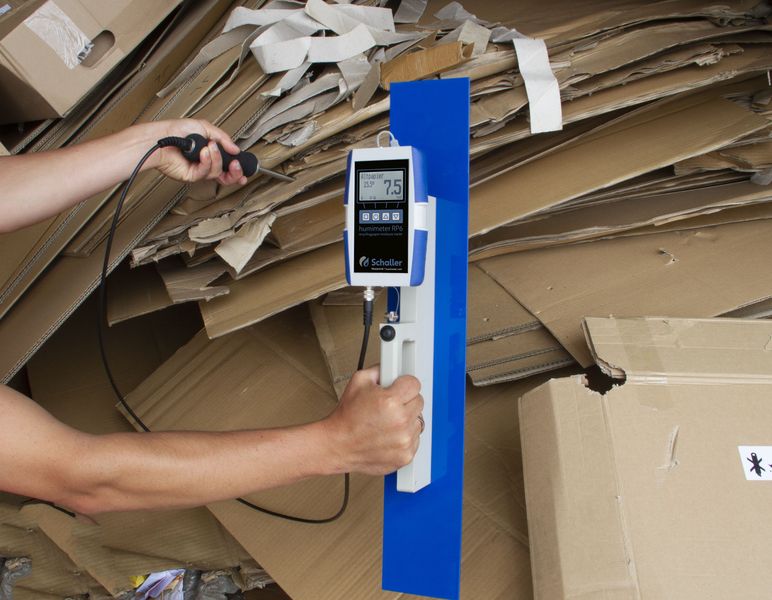
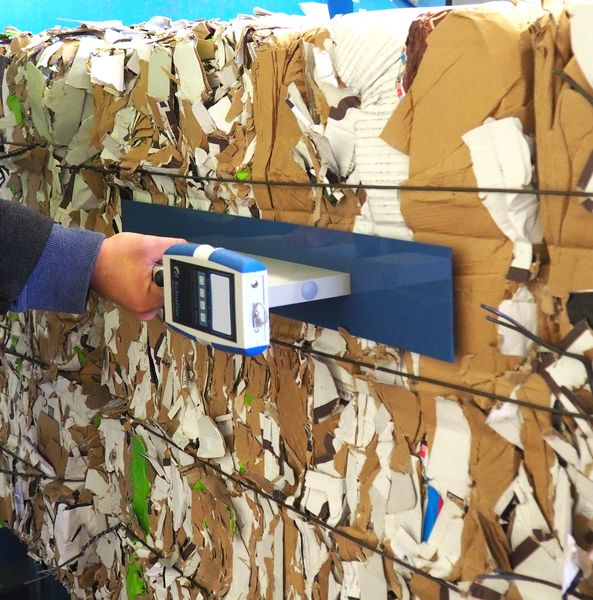
Bale moisture measured without taking the bale apartA bale of recovered paper is bought by weight, and the water in it weighs exactly as much as the paper. The humimeter RP6 is placed against the surface of the bale and gives the water content in seconds - to a depth of 500 mm, that is through the whole bale rather than just the outside. The same movement finds damp pockets, which turn into mould and loss during storage. |
 |
The reading depends on how tightly the material is pressed, so the RP6 carries nine curves labelled by density: 250, 300, 350, 400, 450, 500, 550, 600 and 650 kg/m³. There is also a free slot for a curve of your own for an unusual grade, and a separate check curve used only for testing the instrument. Choosing the curve that matches the real density of the bale is the first condition of a sensible result.
The device itself measures with the measuring plate held against the bale. The external probe socket adds two more ways of measuring.
| Art. no. | Picture | Description |
|---|---|---|
| 13837 |
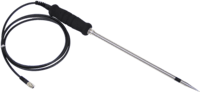 |
Stainless steel insertion probe, 0.3 m long, for recovered paper and corrugated board. Useful where the material is loose or stacked rather than pressed into a bale. |
| 12004 |
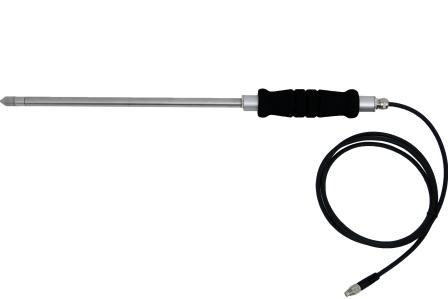 |
LF_TB 120 precision probe: head in a 0.3 m stainless steel tube with a sintered cap, 2 m cable. Relative humidity 0 to 100 % RH, calibration 10 to 90 % RH ±1.5 % RH at 23 °C. |
How a measurement is taken
|
 |
Operating manual v2.9 recommends checking the calibration every four weeks using the check curve and the test plate. For unusual grades the manufacturer offers an additional test medium in a wooden case (art. no. 10726); it is not needed for a routine check.
| Parameter | Value |
|---|---|
| Article number | 13300 |
| Measuring range | 1 to 50 % water content, depending on the material |
| Resolution | 0.5 % water content; 0.5 °C/°F temperature |
| Measuring depth | 500 mm |
| Operating temperature | 0 to +50 °C |
| Storage temperature | -20 to +60 °C |
| Temperature compensation | automatic |
| Protection rating | IP 64 |
| Display | backlit matrix display 128 × 64 |
| Memory | hold function, automatic and manual logger for 10 000 readings with measuring point reports |
| Power supply | lithium-ion battery 1800 mAh, 60 to 100 hours of operation |
| Charging time | up to 6 hours |
| Current consumption | 60 mA with the backlight on |
| Dimensions | 620 × 100 × 147 mm |
| Weight | 1.0 kg with the battery |
| Menu languages | English, German, Italian, French, Spanish, Portuguese, Czech, Russian, Polish, international |
The USB module with the software is included, so moving readings to a PC costs nothing extra. An external probe is an option - it is not needed for measuring bales.
The RP6 is made for pressed bales and sorted recovered paper - it measures deep and through dense material. For paper and solid board in a stack there is the humimeter PMP, selected by the density of the paper, and for equilibrium humidity in a stack the humimeter RH5 with its sword probe. Three different jobs and three different instruments; we are glad to help pick the right one.


 Polski